
Bridges Across the Atlantic: A week on the East Coast Building the Case for Ireland's Endangered Heritage
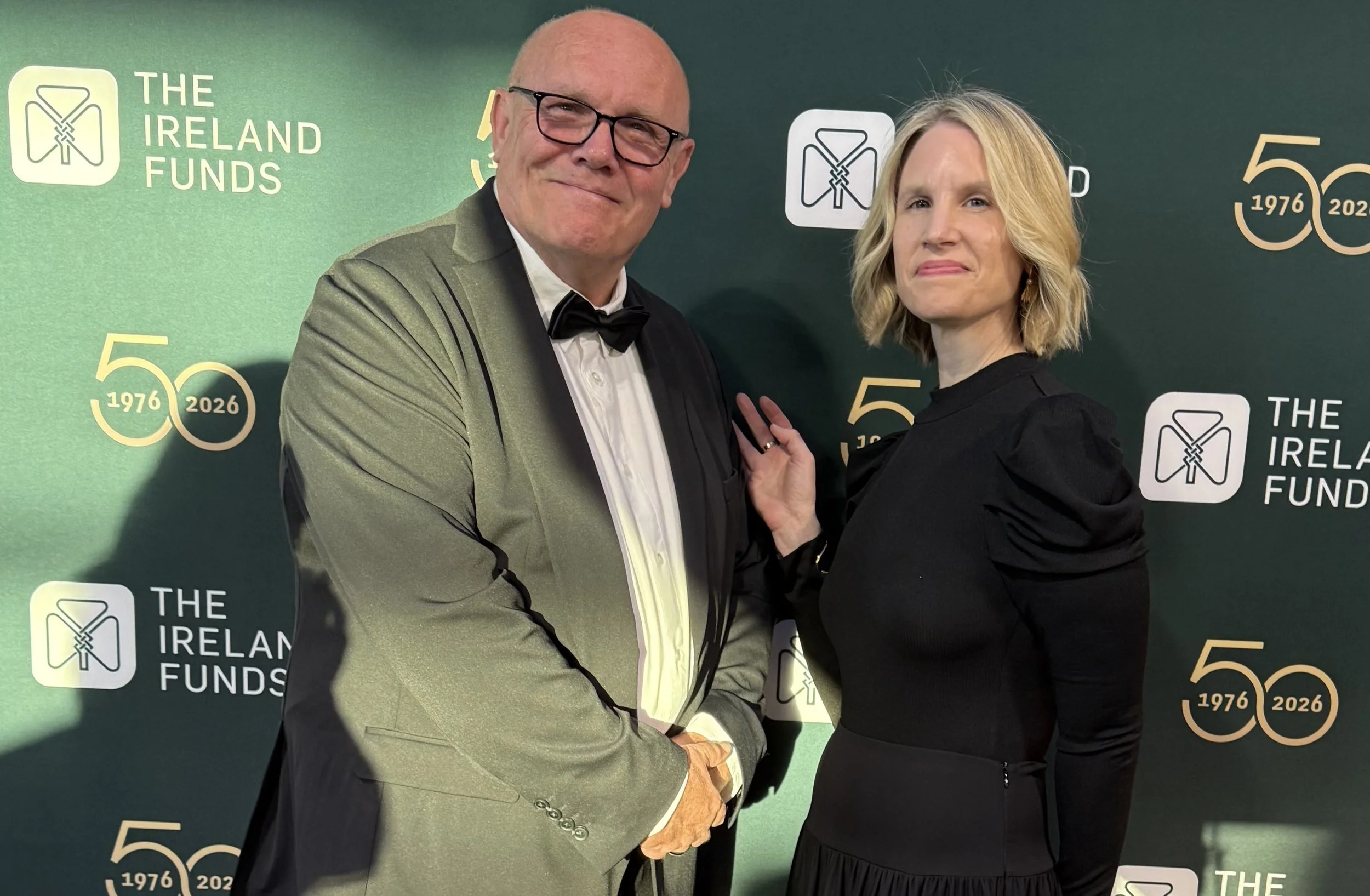
An Taice CEO, Gary Freemantle & Friends of An Taisce Board Chair, Karaugh Brown, attended the Irish Funds Gala in New York on May 7th 2026.
Ireland's built heritage is disappearing quietly. Thatched stone cottages fall into ruin in the Gaeltacht. Schoolhouses once full of children's voices stand empty in Roscommon. Lock keepers' cottages along the Boyne Navigation slowly yield to ivy and damp. For Friends of An Taisce, the challenge is not only to save these places — it's to find the partners, funders, and allies who believe they're worth saving.
That conviction brought a small delegation — Mary Anthony, Gary Freemantle, CEO of An Taisce, and Board Chair Karaugh Brown—to the American East Coast in the first week of May 2026. Over five days they crossed four cities, held nearly a dozen meetings, and attended one of the most prominent celebrations of Irish-American philanthropy of the year.
— Philadelphia —
Monday, May 4
City of Brotherly Love — and Shared Principles
The trip began in Philadelphia, where Executive Director Shawn McCaney received the delegation for a noon meeting —The William Penn Foundation has long championed the cultural and civic life of the Delaware Valley.
From there, a short drive brought them to Havertown and the Irish Diaspora Center on West Chester Pike. Una McDaid, Executive Director, welcomed the group to a conversation about how the Philadelphia Irish community might engage with An Taisce's work back home. The Irish Diaspora Center has become a hub for the region's Irish and Irish-American population, and for FoAT, building those diaspora connections is as important as any single funding conversation.
By evening, they were on the train south to Washington.
— Washington, D.C. —
Tuesday–Wednesday, May 5–6
The Capital — Diplomacy, Architecture, and Community
Washington offered a different kind of conversation. At The Doyle hotel, FoAT met with Katie Williams of the L'Enfant Trust, an organization dedicated to the preservation and interpretation of Washington's historic fabric. Across the table, two organizations from different countries found they were asking some of the same questions: who takes responsibility for the built environment when markets fail and government is stretched thin? Katie and her colleague, Lauren McHale, traveled to Dublin two weeks later to share information with heritage professionals from across Ireland.
Later that morning, the group met the dynamic Aideen Gilmore — president of Irish Network DC — who joined the group for coffee and a longer conversation about the Irish community in the capital. FoAT already has roots in this city; the meeting was about deepening them.
"The diaspora doesn't just fund heritage — they carry it. Every meeting on this trip was a reminder of how alive Ireland is in American cities."
That visit to the Embassy came the following morning. At 1700 Pennsylvania Avenue, Deputy Ambassador Fionnuala Quinlan and Press and Public Diplomacy Counsellor Stephen O'Shea received the delegation warmly. The meeting built on the December 2025 conversation between Michelle Prior, Emma Saggers, and Stephen and set the stage for a reception to be held on October 28th of this year.
— New York —
Thursday–Friday, May 7–8
New York — Preservation, Philanthropy, and a Gala
New York was the most concentrated stretch of the trip. Thursday began at the J.M. Kaplan Fund, where Executive Director Julia Bator heard an update on the properties initiative. The Kaplan Fund has long been a supporter of preservation and heritage work; Julia had attended FoAT's October 2025 event, and this meeting was a chance to show progress, and share thinking on the revolving fund model, and invite deeper engagement.
Over lunch, the group was joined by Anne Anderson, the former Irish Ambassador who shared her remarkable breadth and depth of experience.
At Rockefeller Center, the World Monuments Fund received the delegation on the 25th floor. Karaugh Brown, Friends of An Taisce Board Chair, who worked at WMF from 2020 to 2024, knows the organization well and led the conversation. An Taisce has submitted a nomination for the 2027 World Monuments Watch, a biannual program that spotlights endangered heritage sites around the world. The nomination focuses on the stone thatched cottages of the Gaeltacht. No site in the Republic of Ireland has ever made the Watch; the group is hopeful this application, which also touches on sustainable building trades and the 2030 climate agenda, could be the first.
At 3:30 pm, the group made their way to the MetLife Building for a meeting with Consul General Gerald Angley. CG Angley attended the October 2025 FoAT gala in New York and has been a warm supporter since.
Thursday evening brought the trip's most formal occasion: the Ireland Funds Gala at Pier 60, Chelsea Piers. Celebrating fifty years of Irish-American philanthropy, the event honored Anthony Smurfit of Smurfit Westrock and singer-songwriter Carole King. FoAT representatives were inspired by the crowd of Irish and Irish-American leaders, thoughtful conversations, and the strong enthusiasm for supporting Irish programs.
Friday morning began early, back at the MetLife Building for the Consulate's monthly morning gathering featuring acclaimed musician Cormac Begley and Chieftains legend Matt Molloy along with the Irish Traditional Music Archive (ITMA). They swapped stories, played a few tunes, and gave us a sneak preview of Across the States: An Irish Cultural Atlas of America—a new interactive digital map tracing the history and living tradition of Irish music and dance across all 50 states, as part of Ireland’s America250 program.
— What it's all about —
The Work Behind the Journey
Every conversation on this trip pointed back to the same set of properties. A lock keeper's cottage along the Boyne Navigation in Navan — picturesque, near Newgrange and Slane Castle, supported by Meath County Council for redevelopment as a café or community amenity. The Cloontuskert School and house in Roscommon, part of a planned peat-cutting community, soon to be transferred to An Taisce by the OPW for new community use. And the thatched stone cottages of the Gaeltacht — thousands of them, derelict but restorable, waiting to become both homes and classrooms in the traditional building trades.
The program is built on the revolving fund model — acquiring difficult properties that don't work for private buyers or government agencies, restoring them, then selling or leasing them for uses the local community wants. Seed funding from the 1772 Foundation, a leading American preservation funder, has given the program its start. The East Coast trip was about building what comes next.
A week of trains, meetings, handshakes, and lively dinners. Heritage work is slow and painstaking by nature. But every conversation is a stone laid.